Plenty of people have tried it: swapping the office chair for an exercise ball. It seems logical. On a ball you're less likely to slump. Your pelvis keeps making small movements, you sit up on your own and you keep shifting position without thinking about it.
Reality turns out differently. The ball rolls away when you stand up, it's never quite the right height and it takes up a lot of space. Most office balls end up deflated in a cupboard.
What a ball gets right
A ball has no fixed seat. It gives way wherever you put your weight, so your pelvis tilts forwards, backwards and to the sides. That's the right movement: small, constant and without having to think about it.
Swivvy started here. Inventor Ira Mossou was looking for a better seat for her daughter, who spent long days behind a computer. A ball moved the right way, but it didn't work in the room. So Ira built her own: a cushion that moves like a ball, on a seat that stays where it is. You can read the full story in From a handmade cushion to a patented motion system.
Three problems with a ball at the office
It rolls away
Stand up, and the ball is off. Under the desk, against a cabinet, into the walkway. Before you can sit back down, you have to fetch it. And in a shared office, sooner or later someone trips over it.
Its height is its size
You can't adjust a ball. Its height is its diameter, minus however far it sinks under you, and that depends on how hard it's pumped up. Size charts don't help much either: shops recommend the same 65 cm ball for people from 160 to 185 cm tall. If you buy the wrong size, you're stuck with it.
It takes over the room
An exercise ball is a big object to have next to your desk, and it doesn't look like furniture. Most people put it away after a while, simply because it's in the way.
There's also a limit to how long a ball stays comfortable. In a study from 2006, people who did an hour of computer work on a ball reported more discomfort in their lower back than after an hour on an office chair.
The same movement, on a stool that stays put
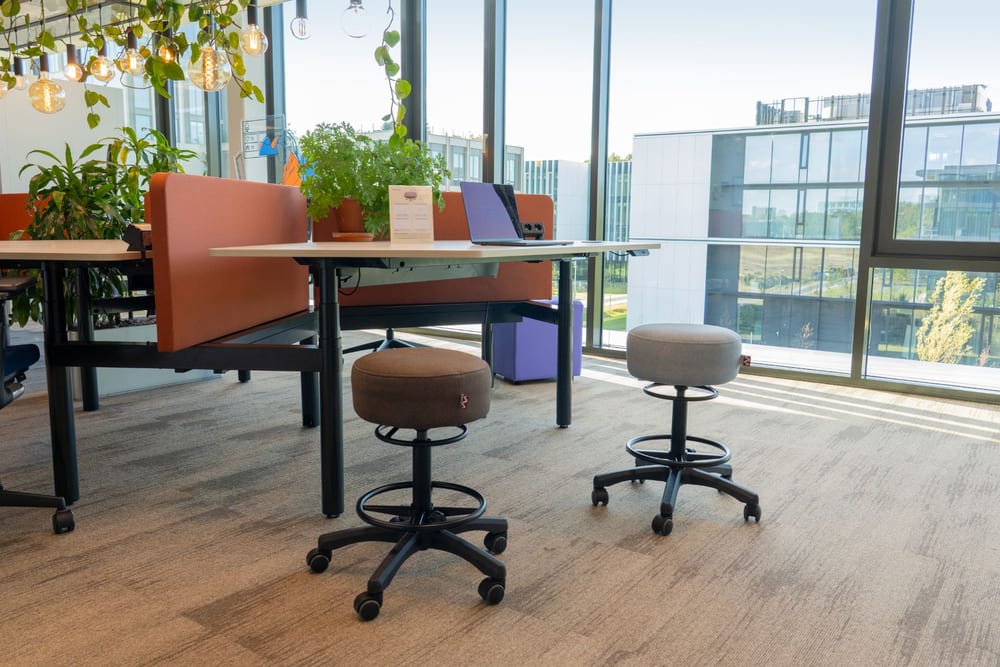
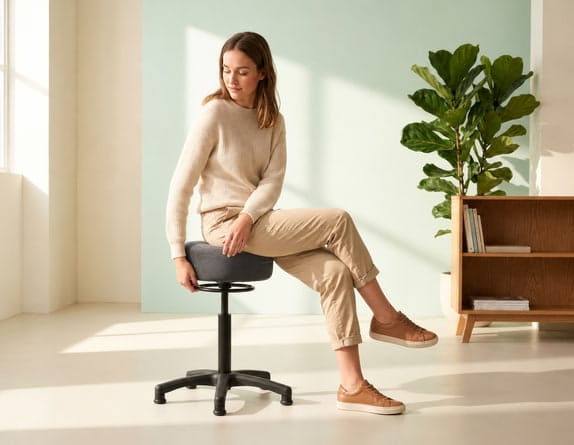
The Swivvy Office keeps a ball's strong points and fixes the weak ones. Under the cushion sits a mechanical hinge that lets the seat tilt up to 22.5 degrees in every direction. Your pelvis moves the way it does on a ball, while the base stays still.
Exercise ball
Seat tilt 0°
Moved across the floor 0 cm
Swivvy Office
Seat tilt 0°
Moved across the floor 0 cm
| Exercise ball | Swivvy Office | |
|---|---|---|
| Movement | Rolls and gives way | Tilts around a hinge in the seat, up to 22.5° |
| Height | Fixed by its size and air pressure | Adjustable: 43 to 78 cm, depending on the stand and height (S or L) |
| When you stand up | Rolls away | Stays where it is |
| Sitting still | Not possible | Lock the seat with a lever |
| Maintenance | Pumping up, risk of punctures | Nothing to pump up: the movement is mechanical |
| Footprint | About 65 cm across | From 40 cm across (Disc base) |
There's no air in the seat, so there's nothing to pump up and nothing to leak: the tilt comes from a mechanical hinge, and it doesn't slowly sag the way a ball does. And because the base has its own stand, you choose how it sits in your room: a five-star base without wheels for a fixed spot, load-braking castors if you move around, or a round 40 cm disc for small spaces.
Ball or stool?
To sit on now and then at home, a ball is cheap and does the job. But if you work at your desk for long days, or switch between sitting and standing, you need something that stays put, adjusts to your desk and is still where you left it tomorrow.
A ball also never stops moving. That's fine while you read or think, less so in a video call. On the Swivvy Office you choose as you sit down: moving or still. Use the lever under the seat and the hinge locks in the center.
Looking for something between an exercise ball and an office chair? A wobble stool is worth a look.