
Swivvy didn't start in a design studio or an engineering lab. It started at home, years ago, with my mother, Ira Mossou. She was looking for a better seat for my younger sister Felia, who spent long days behind a computer for school and struggled with sitting still for hours. An ordinary desk chair didn't help, and ergonomic chairs were too expensive. The movement of a ball would have helped, but an exercise ball wouldn't fit in the room and was too unstable anyway. Ira couldn't find anything that worked for Felia.
“If something doesn't exist yet, but I truly need it, then I want to create it myself.”
Two hinges and a cushion
So she started experimenting. Could the movement of a ball fit into something cleaner and more practical? Her first prototype was a cushion with two hinges inside, set at right angles to each other. Together they let the seat move smoothly in every direction, without springs, elastic or air. Your hips could move the way they do on a ball, while the seat stayed compact and where you put it.
When she first showed me the concept, I immediately felt there was something special about its simplicity. No complicated mechanisms, just fluent movement from a pair of hinges.
Seven generations of hinge
I took it from there. In 2023 we filed the patent for this invention, and over the next three years the handmade prototype went through generation after generation. Each version solved something the one before it couldn't, until the whole movement fitted into a single module inside the cushion, one that's easy to produce.

In December 2024 the motion system was granted a Dutch patent. The hinge is made in Delft by MAFA Plastics. We developed the Swivvy Office around it with engineers from Vendiboard in Ukraine.
- At homeAt homeThe first cushionIra Mossou builds a cushion for her daughter Felia: two hinges at right angles, no air, no springs.
- 20232023Filing of patentDutch patent filing submitted for the motion system.
- 2023 to 20262023 to 2026Seven generationsEach version solving something the one before it couldn't.
- Dec 2024Dec 2024Patent grantedDutch patent for the motion system.
- 20262026First production runOne hundred Swivvy Office stools.
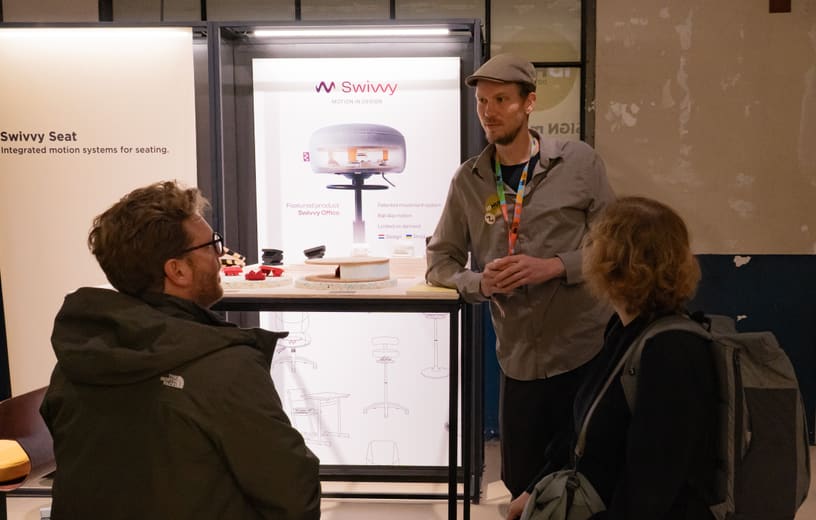
- Oct 2026Oct 2026Dutch Design WeekSwivvy in the Klokgebouw in Eindhoven.
How it moves
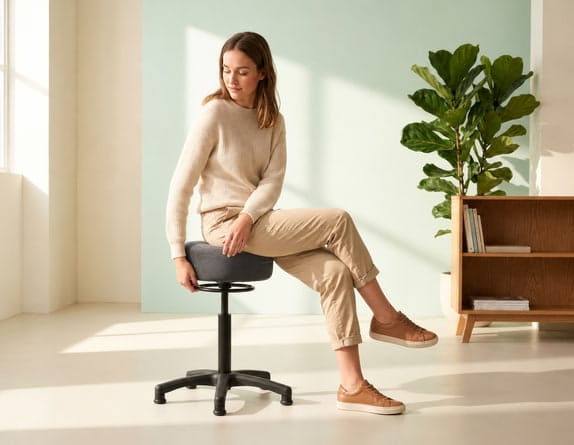
The hinge sits right under where you sit. It lets the seat tilt continuously in every direction, up to 22.5 degrees from the center, while the stand stays still. Because the movement comes from a mechanical hinge rather than air, there's nothing to leak or pump up. The cushion softens a little with use, as any cushion does, but the way it tilts stays the same.
The hinge can also lock. Use the lever under the seat before you sit down, and it locks in the center. That small detail is what makes the Swivvy Office a seat for the whole day: moving when you want to, still when you need to.
One system, more than one seat
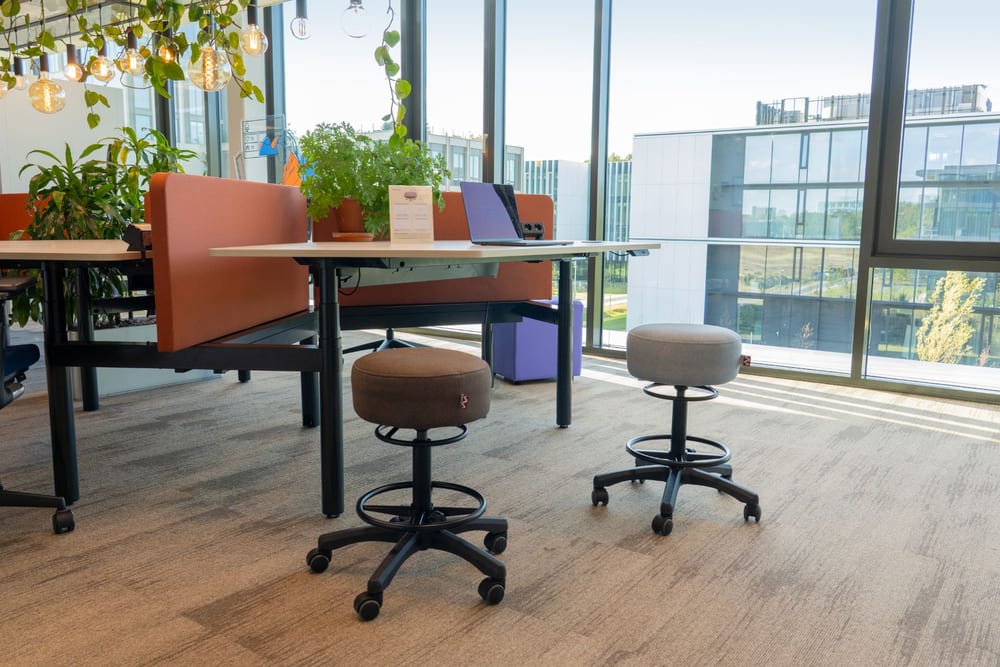
In 2026 we completed the first production run of one hundred Swivvy Office stools, and this October we presented the system at Dutch Design Week in Eindhoven. A second product, Swivvy School, a cushion that gives the same movement in a different form, is now being tested in schools and childcare centers.

It doesn't stop there. The hinge is built as a component: it fits any seat or cushion with 7 cm to spare, and a thinner version is in development. We're keen to work with furniture makers who want it in their own designs. We call this vision Motion in Design. Makers can find the technical details on our industry page.