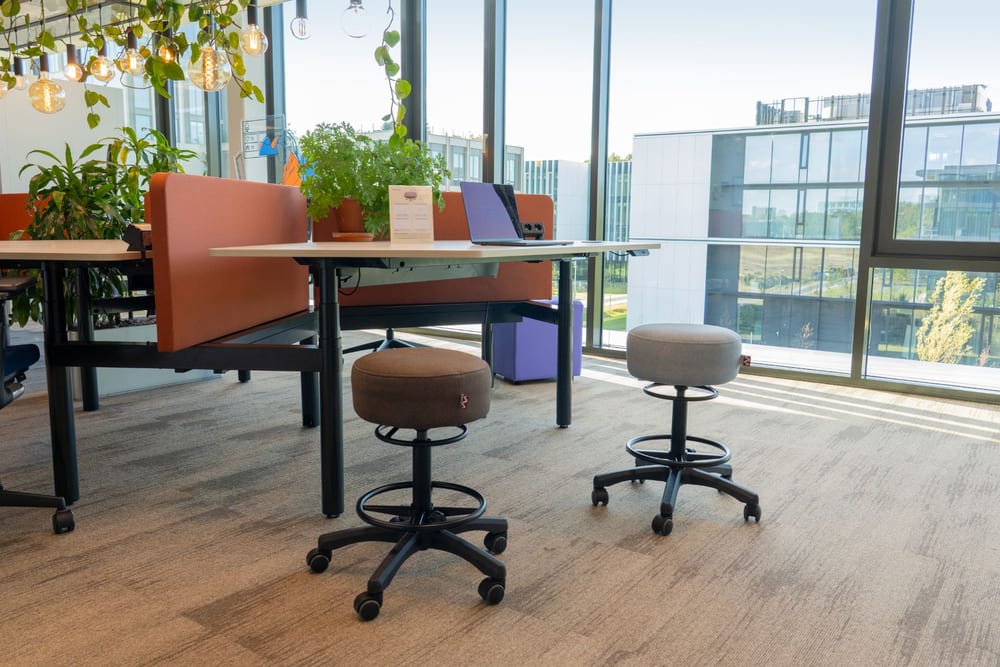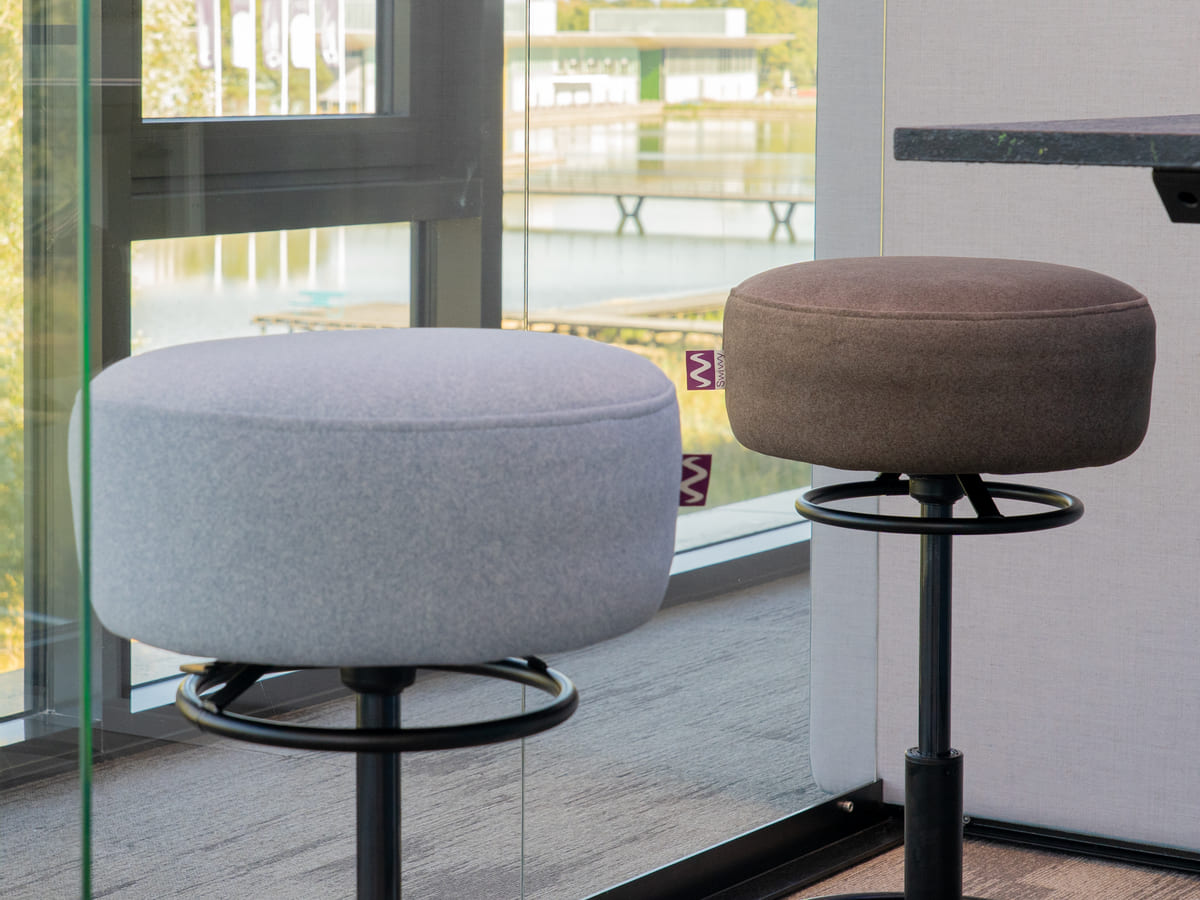
A Swivvy Office costs from €399.95. That's real money for a seat, but it often doesn't have to come out of your own pocket. If you're employed, your employer can usually pay for it tax-free. If you work for yourself, it's a business expense. Here's how both routes work in the Netherlands in 2026.
Employed
- 1Needed for your workplace?An occupational health provision (arbovoorziening): your employer pays for your Swivvy Office tax-free, at the office or at home.
- 2A Swivvy Office at the office?Zero valuation (nihilwaardering): it counts as €0 for tax, under conditions.
- 3Paid from the WKR?The free allowance: in 2026, 2.00% of the wage bill up to €400,000.
Self-employed (zzp)
- 1A separate workspace?A corner of the living room usually doesn't count: then neither the room nor its furniture is deductible.
- 2Under €450?Every Swivvy Office is, even incl. VAT: expense it in one go, no depreciation.
- 3Do you charge VAT?Reclaim the VAT on your Swivvy Office with the invoice from your order.
If you're employed
1. As an occupational health provision
Under the Dutch Working Conditions Act (Arbowet), your employer has to make sure you can work safely and healthily, at the office and at home. The Belastingdienst's payroll tax handbook for 2026 explicitly names "an ergonomically sound office chair" as an example of such a provision (arbovoorziening). Your employer can provide or reimburse it tax-free, as long as:
- it's directly linked to an obligation under the Arbowet;
- you use it at least partly at your workplace or in your home workspace;
- your employer pays for the necessary provision in full.
A Swivvy Office used alongside your office chair doesn't automatically count. It helps if your company doctor or prevention officer (preventiemedewerker) advises it for your workplace, for example because you work at a sit-stand desk or need more variety in your posture.
One catch if your employer gives you a fixed budget for your home workplace. If your Swivvy Office only partly fits in what's left of it, so you pay the rest yourself, it's usually not tax-free. So claim it while the budget still covers it in full.
2. A Swivvy Office at the office
If your employer puts a Swivvy Office at your desk in the office, it can be valued at zero for tax (nihilwaardering). It has to be a reasonable provision that you use at your workplace. That rule covers the stool itself, not a cash allowance.
3. From the work-related costs scheme
Any employer can also pay for a Swivvy Office from the free allowance (vrije ruimte) of the work-related costs scheme (werkkostenregeling, WKR). In 2026 that's 2.00% of the total taxable wage bill up to €400,000, and 1.18% above that. With a wage bill of €400,000, that's €8,000 a year, so a Swivvy Office at €399.95 uses only a small part of it. As long as the employer stays within the allowance, it costs you nothing in tax. Above it, the employer pays an 80% final levy, not you.
The allowance for working from home, €2.45 a day, is a different thing. It's meant for energy, coffee and the like on days you work from home, not for a Swivvy Office.
How to ask your employer
A request is quickest when it's concrete. Put it in a short email to HR, your manager or the prevention officer:
- Where you work, and how many hours a week: at the office, at home or both.
- What kind of desk you have: fixed, or sit-stand.
- Why you want a Swivvy Office: more variety in your posture, a seat that suits your sit-stand desk, less sitting still.
- The product and price: Swivvy Office, from €399.95 including VAT. We're happy to send a quote, for one stool or a whole team, via info@swivvyseat.com.
If you're self-employed
First: where do you work?
If you work from an office, a studio or a coworking space outside your home, a Swivvy Office for that workplace is simply a business expense. At home it's stricter. A desk in the living room or a spare bedroom used as an office usually doesn't count as a separate workspace (zelfstandige werkruimte), and then the costs of furnishing it aren't deductible either, chair or stool included. The Belastingdienst has a tool to check your workspace.
Expense it in one go
If it's deductible for you, you don't have to depreciate a Swivvy Office over several years. Business purchases under €450 can be expensed in one go, and every Swivvy Office is under €450, even including VAT. It counts as a cost in the year you buy it.
VAT
If you use your Swivvy Office for work you charge VAT on, you can usually reclaim the VAT on it, even if it isn't deductible for income tax. You get an invoice with every order.
Still have budget for 2026?
The WKR free allowance is set per calendar year. Whatever your employer hasn't used by 31 December doesn't carry over to 2027. If you're self-employed and a Swivvy Office is deductible for you, buying it in December lowers your profit for 2026.
What changes in 2027
- The WKR free allowance on the first €400,000 of the wage bill goes up from 2.00% to 2.16%. That's already law. Above €400,000 it stays 1.18%.
- The other amounts for 2027, such as the home-working allowance, aren't final yet. The Tax Plan 2027 is still going through parliament, and the final figures follow in December.
Sources
- Belastingdienst, Handboek Loonheffingen 2026: arbo provisions and zero valuation at the workplace (in Dutch).
- Belastingdienst, Werkkostenregeling: the free allowance and the 80% final levy (in Dutch).
- Belastingdienst Kennisgroepen, Budget arbovoorzieningen, 2026: fixed budgets for arbo provisions (in Dutch).
- Belastingdienst, Werkruimte in je woning and the workspace check (in Dutch).
- Belastingdienst, Kosten die u in 1 jaar mag aftrekken: the €450 threshold (in Dutch).